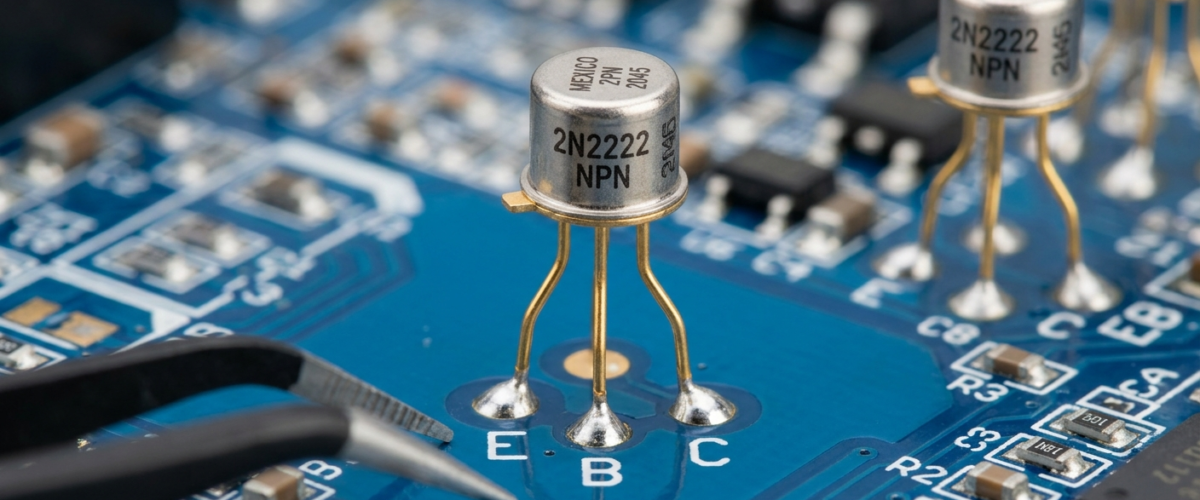
A transistor is one of the smallest and most important components in the history of technology. At its core, it is a tiny semiconductor device that does two things — it amplifies electrical signals and acts as a switch that controls the flow of electricity. Think of it like a microscopic tap: a small signal at one end controls a much larger flow of current at the other. That ability to control electricity at a tiny scale is exactly why transistors became the foundation of every computer, smartphone, radio, and electronic device on the planet. Without the transistor, there is no internet, no modern medicine, no smartphones, no AI — essentially none of the technology we depend on today would exist.
A Discovery That Changed Everything
Before transistors, electronics ran on vacuum tubes — glass bulbs the size of a fist that heated up, burned out constantly, and consumed enormous amounts of power. Early computers filled entire rooms because of them. Everything changed on December 23, 1947, when three physicists — John Bardeen, Walter Brattain, and William Shockley — at Bell Labs in New Jersey successfully demonstrated the first working transistor. They were not trying to rewrite history. They were simply trying to improve telephone calls by finding something smaller and more reliable than the vacuum tube. What they built instead was a tiny germanium device using two gold contacts pressed against a semiconductor surface — and it worked. The three men shared the Nobel Prize in Physics in 1956 for their achievement. The name “transistor” itself was coined a few months later by Bell Labs engineer John Robinson Pierce — a combination of the words “transfer” and “resistor.” Within a decade, transistors replaced vacuum tubes entirely, and the world of electronics was never the same.
How Transistors Power the World Today
Today, transistors are everywhere — and they are almost impossibly small. A modern smartphone chip contains over 15 billion transistors packed into a space the size of a fingernail. The principle driving this is Moore’s Law, observed by Intel co-founder Gordon Moore in 1965, which noted that the number of transistors on a chip doubles roughly every two years — and this has held true for over half a century. Modern transistors are measured in nanometers; for context, a single strand of human hair is about 80,000 nanometers wide. The latest chips from TSMC and Intel are built at 3 and 2 nanometer scales. Beyond computing, transistors power everything from the braking systems in your car to the satellites orbiting Earth. And as AI becomes more demanding, the semiconductor industry is pushing transistor technology further than ever — exploring 3D chip stacking, carbon nanotube transistors, and even quantum transistors that operate on the principles of quantum mechanics. The small device invented in a New Jersey lab in 1947 is still, remarkably, the engine of the future.
-Neeraj